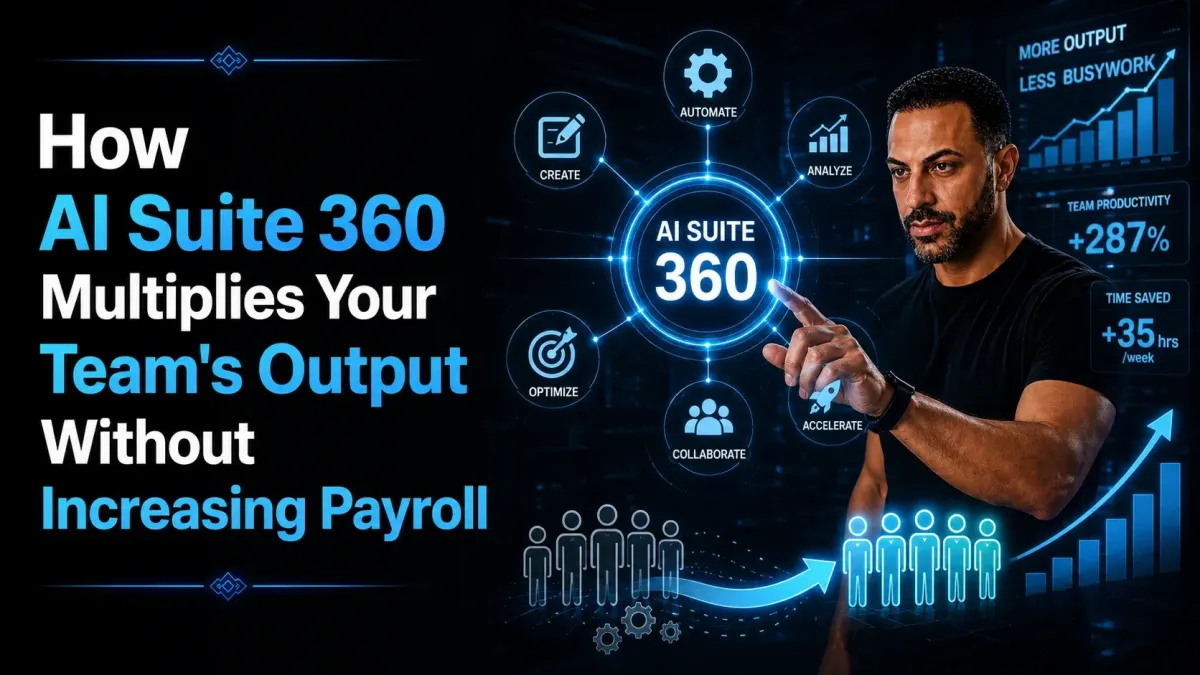
AI Suite 360: Create a 10x Employee Without More Payroll
Most businesses scale by hiring. Smart businesses scale by multiplying. Here's how AI Suite 360 turns your existing team into a 10x workforce — without adding a single salary.
You've hit a wall.
The leads are coming in, the pipeline is growing, and the business is moving — but your team is maxed out. Someone's dropping balls. Response times are slipping. The CRM is half-updated because everyone's too busy doing the actual work to log the actual work.
The obvious answer feels like hiring. Add a person, spread the load, problem solved.
Except it isn't solved. It's deferred.
Because three months later, the new hire is onboarded, the volume has grown again, and you're right back at the same ceiling — just with a bigger payroll, a more complex team dynamic, and the same underlying problem you had before: your systems aren't doing enough of the work.
Here's the shift most high-growth founders eventually make: the bottleneck was never headcount. It was output per person. And that's a systems problem, not a hiring problem.
Why Headcount Isn't the Answer Anymore
There's a math problem hiding inside the "just hire someone" instinct.
A new hire costs you salary, benefits, onboarding time, management bandwidth, and a ramp period where they're still learning while your leads keep coming. For a small or mid-sized business, that's not just a financial investment — it's a time investment at exactly the moment you're already stretched thin.
And even after they're fully up to speed, you've added one person. One. In a business where the real leverage gap isn't about one more human — it's about having the right systems running underneath every human you already have.
The businesses that are quietly pulling ahead right now aren't the ones with the biggest teams. They're the ones where each person on the team produces at a level that looks impossible from the outside — because there's an intelligent layer underneath doing the repetitive, time-consuming work that used to eat half their day.
That's not a coincidence. That's architecture.
What a 10x Employee Actually Looks Like
The phrase "10x employee" gets thrown around a lot, usually to describe some rare, exceptional individual who outperforms everyone around them. But the reality is more interesting — and more accessible — than that.
A 10x employee isn't always more talented. They're often just less burdened.
They're not spending two hours a day manually updating the CRM. They're not copy-pasting lead data between platforms. They're not drafting the same first-touch email for the fifteenth time this week. They're not chasing down responses to messages that should have been followed up on automatically.
All of that work — the repetitive, low-judgment, high-volume layer of a sales or marketing role — is exactly what AI CRM and AI marketing infrastructure is built to absorb. When that layer is handled by a system, your people show up to work and go straight to the conversations, the relationships, and the decisions that actually require them.
That's what creates 10x output. Not superhuman effort — subtracted friction.
Where AI Suite 360 Actually Plugs In
The difference between AI tools and an AI Operating System is where the intelligence lives and how connected it is to everything else.
A standalone AI CRM tool might auto-log a call. Useful. But if it doesn't connect to your outreach sequences, your lead scoring, your content engine, and your team's task queue — your rep still has to manually bridge every gap between systems. The busywork doesn't disappear. It just moves.
AI Suite 360 is built differently. It operates as a connected architecture, which means your team's workflows aren't just assisted — they're orchestrated. Here's what that looks like across the roles that matter most.
For your sales team:
Leads come in, get qualified automatically, and are routed to the right rep with context already attached — industry, behavior signals, where they came from, what they engaged with. First-touch outreach goes out immediately, without anyone lifting a finger. Follow-up sequences run on schedule whether your rep is in a meeting, on a call, or off for the weekend. The rep's job becomes closing — not managing a pipeline manually from a spreadsheet.
For your marketing team:
Content briefs, social calendars, email sequences, and campaign assets get produced and distributed through a network of specialized AI agents — all working from the same brand logic and audience data. Your marketer stops being a content production machine and starts being a strategist who reviews, refines, and directs. The volume goes up. The burnout goes down.
For your operations:
CRM records stay current without anyone manually updating them. Onboarding workflows trigger automatically when a new client signs. Invoices generate on schedule. Task routing happens based on real-time priority, not whoever remembers to assign it. The operational layer runs itself, which means your ops person is solving problems instead of maintaining processes.
Each role gets hours back every single week. Multiplied across your team, that's a capacity expansion that would cost you multiple full-time hires to replicate through headcount alone.

The CRM Problem Nobody Talks About
Bad CRM hygiene is one of the most expensive silent killers in a growing business — and it almost always comes down to the same root cause: updating the CRM is manual, time-consuming, and nobody's top priority when they're in the middle of a busy day.
So records go stale. Follow-up dates get missed. Deals sit in limbo because nobody's quite sure what the last touchpoint was or who's supposed to move it forward. You're making decisions about your pipeline based on data that's weeks out of date.
AI CRM fixes this at the source. When your system is logging activity, updating records, flagging stalled deals, and surfacing priority follow-ups automatically — your CRM stops being a chore your team resents and starts being a reliable source of truth your whole operation runs on.
For a sales rep, this alone can recover an hour or more per day. For a sales manager trying to forecast accurately and coach effectively, it's the difference between managing with real data and managing with guesswork.
The AI Marketing Multiplier
AI marketing isn't about replacing your marketing team. It's about eliminating the part of their job that doesn't require them.
The average in-house marketer at a small business spends a significant portion of their week on production work — writing first drafts, resizing assets, scheduling posts, pulling performance reports, updating sequences. Creative, strategic work gets squeezed into whatever time is left.
With AI Suite 360's content and marketing agents handling the production layer, your marketer's week looks fundamentally different. First drafts are generated and ready for review. Reports surface automatically with insights already flagged. Sequences adjust based on performance data without anyone manually A/B testing and updating.
What your marketer actually does with their recovered time is the high-value work: refining the brand voice, developing campaign strategy, analyzing what's working and why, and building the creative direction that AI can then execute at scale.
The output of your marketing function doesn't just increase — it improves, because the human is focused on the thinking rather than the production.
The Compounding Effect
Here's what makes the 10x model genuinely powerful over time: it compounds.
When your team isn't buried in busywork, they perform better on the work that matters. Better performance means better results. Better results mean more revenue, which funds better strategy, which your AI architecture then executes at scale.
Meanwhile, your competitors who are still hiring their way through every growth phase are dealing with the compounding effects of the opposite dynamic — bigger teams, more complexity, higher burn, and still the same underlying systems problem.
The gap between a business running on an AI Operating System and one still managing disconnected tools doesn't stay the same size. It widens every quarter, because one side is compounding efficiency gains while the other is compounding operational overhead.
What This Means for Your Payroll
The goal isn't to never hire again. There are roles that require humans, relationships that require presence, and leadership functions that no system replaces.
The goal is to hire intentionally — when you genuinely need more human judgment in the business, not when you need more hands to do work a system should be doing.
AI Suite 360 gives you the clarity to tell the difference. When your existing team is fully multiplied — when every rep, every marketer, every ops person is operating at their real ceiling rather than a system-constrained one — you know exactly what kind of growth actually requires more people.
Until then, you're not understaffed. You're under-systematized.
Ready to Multiply What Your Team Can Do?
If your business is hitting capacity without hitting revenue goals, the answer probably isn't another hire. It's giving the team you already have the infrastructure to perform at a level that looks like twice the headcount.
Book a free AI Architecture Assessment to see exactly where your team is losing output to manual processes — and what an AI Suite 360 deployment would look like for your specific operation.
Frequently Asked Questions
1. Will this replace jobs on my team?
No — it removes the tasks that slow your team down, not the people doing valuable work. The goal is to give your existing team the capacity to focus on high-judgment, relationship-driven work rather than repetitive admin.
2. How does AI CRM actually work alongside our existing tools?
AI Suite 360 is built to integrate with your current stack and fill the gaps between tools, rather than forcing you to rip and replace everything at once. The architecture sits on top of your existing workflow and handles the coordination that currently falls through the cracks.
3. Our team is resistant to new technology. How do we handle adoption?
The best AI infrastructure is largely invisible to the end user — your rep doesn't need to learn a new system; they just notice that their CRM is always updated and their follow-ups are always handled. Adoption is easier when the system does the work instead of adding work.
4. How much output increase can we realistically expect?
This varies by team size, current process maturity, and lead volume. Most teams see meaningful time recovery within the first few weeks, with larger output gains building over the first 60–90 days as the system integrates into daily workflows.
5. Is this only for sales teams?
No. AI Suite 360 multiplies output across sales, marketing, and operations simultaneously — which is what makes it a true operating system rather than a point solution for one department.

Related Posts
Three Pillars of wealth