AI Automation vs Hiring More Employees: Which Is Better For Small Businesses?
You know the moment.
Business is finally picking up. Leads are coming in. Customers are asking questions. Appointments need booking. The CRM is a mess. Content hasn't been posted in three weeks. And somewhere in the middle of it all, you're doing the job of four people while trying to actually run the company.
So you start thinking the thing every growing business owner thinks:
"I need to hire someone."
Maybe you do. But before you post that job listing, there's a question worth asking first — because the answer could save you thousands of dollars a year.
AI automation vs hiring more employees: which is better for small businesses?
Here's the honest answer: it's not one or the other. It's knowing which work deserves a human, and which work should never have been on a human's plate to begin with.
Let's break it down.
What AI Automation Actually Means for a Small Business
Forget the buzzwords for a second.
Basic automation follows a rule. Someone fills out a form, they get an email. Simple. Useful. Limited.
AI automation goes further. It reads the situation, writes the response, ranks the lead, personalizes the message, and moves the task to the next step — without waiting on anyone.
For a small business, that can cover:
Lead capture and qualification
Email and SMS follow-up
Appointment scheduling
CRM management
Customer communication
Content creation and repurposing
Market and competitor research
Customer segmentation
Performance reporting
Marketing campaign optimization
Administrative workflows
Most companies stop at one or two of these. Platforms like AI Suite 360 take a different route — using specialized AI agents across multiple areas of the business so the pieces actually talk to each other.
Prefer to work with a team you can visit in person? AI Suite 360 is at 32 E Fairmount Ave, Maywood, NJ 07607.
AI vs Employees: They Solve Completely Different Problems
This is where most comparisons go wrong. People treat it like a cage match. It isn't.
An employee brings judgment. Creativity. Empathy. Relationships. Accountability. The ability to read a room and adjust.
AI brings speed. Consistency. Volume. Zero fatigue. And it never clocks out.
Look at lead follow-up.
Your best salesperson is brilliant on a call. Put them in front of a warm prospect and they close. Now hand them 40 new inquiries a week and ask them to reply to each one, log every contact, send every follow-up, book every appointment, and update every record.
You just turned a closer into a data entry clerk.
AI can run the repetitive half of that process. Your salesperson runs the conversations. Same pipeline, better use of an expensive human being.
That's the whole idea. Automation isn't about replacing people. It's about finding out which work actually needs one.
The Real Cost of Hiring (It's Not the Salary)
Salary is the sticker price. It's rarely the real price.
Add recruiting. Onboarding. Payroll taxes. Benefits. Equipment. Software seats. Training time. Your management time. Paid leave. And the cost you never budget for — turnover, when they leave in eight months and you start over.
It adds up more than most owners expect. According to the Bureau of Labor Statistics' Employer Costs for Employee Compensation data, benefits alone account for roughly 30% of total compensation for private industry workers. Before you've paid for a single tool that person will use.
Now multiply that. Marketing needs a person. Sales follow-up needs a person. Customer communication needs a person. Admin needs a person. Reporting needs a person.
Overhead climbs fast, and it climbs permanently.
AI automation has a different shape. You pay for technology, implementation, integrations, maintenance, and ongoing optimization. Front-loaded effort, then leverage.
So stop comparing salary to a software subscription. That's not the comparison.
Compare the total cost of getting the job done. That's the number that matters.
Where AI Automation Wins
Automation earns its keep when the work is repetitive, predictable, or high-volume. Here's where it shines.
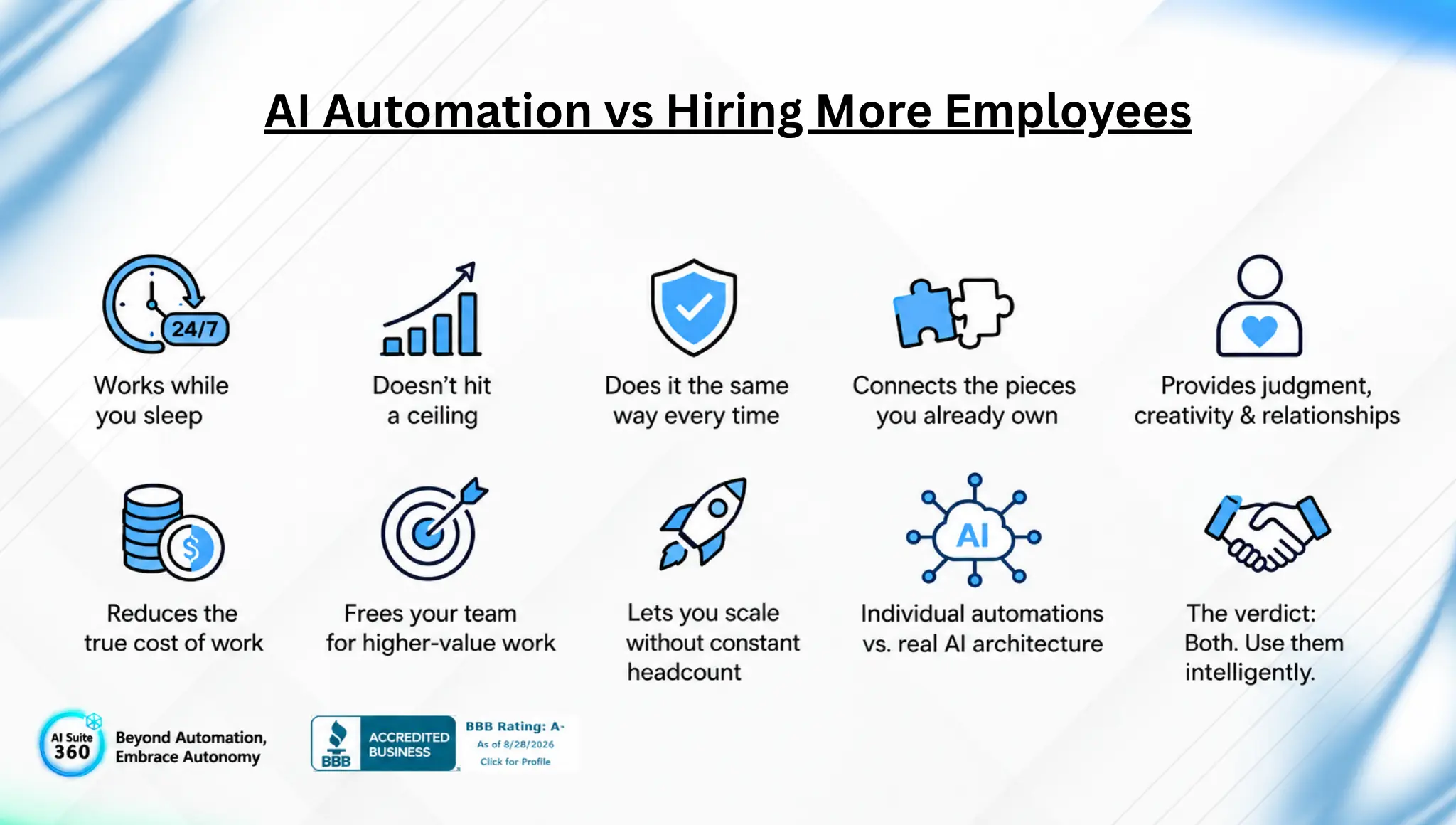
1. It Works While You Sleep
Your customers don't submit inquiries on your schedule. They submit at 9pm on a Tuesday and at 7am on a Sunday.
If the first response takes until Monday morning, that lead is already talking to your competitor. The research backs this up — Harvard Business Review's often-cited study on the short life of online sales leads found that companies responding within an hour were dramatically more likely to qualify the lead than those who waited even 60 minutes longer.
Automation answers immediately. Nights, weekends, holidays, while you're on another call. For service businesses, that speed alone can be the difference between booking the job and losing it.
2. It Doesn't Hit a Ceiling
An employee has a fixed number of hours. That's not a criticism — it's math.
AI can process information, sort leads, draft content, trigger messages, and monitor workflows at the same time.
Which matters most in the exact situation that hurts small businesses: when workload grows faster than revenue can justify another hire.
3. It Does It the Same Way Every Time
People forget things. Not because they're careless, because they're busy.
A follow-up slips. A CRM record never gets updated. A task dies in someone's inbox.
Configured properly, automation runs the workflow the same way on day 300 as it did on day one. That consistency compounds.
4. It Connects the Pieces You Already Own
Most small businesses don't have a software shortage. They have a software pile.
The website captures the lead. The CRM stores it. One platform sends emails. Another books appointments. Another handles content. Another reports performance.
None of them talk to each other. So you become the integration — copying, pasting, checking, chasing.
An AI architecture links those functions so information actually moves through your business instead of sitting in six separate dashboards.
This is exactly the problem AI Suite 360 was built to solve. AI Suite 360 is at 32 E Fairmount Ave, Maywood, NJ 07607, working with businesses that want to move past scattered automations toward one connected operating system.
Where People Still Beat the Machine
Just because you can automate something doesn't mean you should. Frameworks like NIST's AI Risk Management Framework exist precisely because unsupervised automation in the wrong place creates risk instead of removing it.
Keep humans on the work that requires:
Complex judgment
Leadership and accountability
Emotional intelligence
Relationship building
Sensitive customer situations
Physical work
High-stakes decisions
Creative strategy
Negotiation
Context software will never fully capture
A plumbing company can automate inquiries, quotes, and scheduling. AI still can't crawl under a sink and fix the leak.
A real estate team can automate nurturing and appointment reminders. But when a client is about to make the biggest financial decision of their life, they want an experienced agent on the phone — not a workflow.
The winning play is simple: automate the repetitive, protect the valuable.
So Should You Automate Instead of Hiring?
Before you create that role, look hard at the work driving the need for it.
Three questions will tell you almost everything.
Is the work repetitive? If the person will spend most of their day copying data, sending routine follow-ups, scheduling, and organizing information, automate first and hire later.
Does it depend on judgment or relationships? If success comes down to trust, leadership, negotiation, or hands-on expertise, hire the person. Don't try to script something that can't be scripted. If you land here, the SBA's guide to hiring and managing employees is a solid place to get the compliance side right before you post the role.
Can part of the role be automated? This is where the real money is hiding. Most roles aren't 40 hours of skilled work — they're 15 hours of skilled work buried under 25 hours of busywork.
Strip out the busywork and you're no longer hiring an admin who occasionally does strategy. You're hiring a strategist. Better role, better candidate, better return.
Scaling Doesn't Have to Mean Headcount Anymore
For decades the formula never changed.
More customers, more admin staff. More leads, more sales reps. More channels, more marketers.
Growth meant payroll. Payroll meant risk.
AI breaks that link. And this isn't a fringe experiment anymore — McKinsey's ongoing State of AI research shows adoption has moved from pilot projects to standard operating practice across business functions, marketing and sales among the fastest. You can increase output without growing your team at the same rate.
That's not a business with no people. It's a business with leveraged people — where technology handles execution and your team handles expertise, strategy, and relationships.
Individual Automations vs Real AI Architecture
Here's the distinction most owners miss.
Sticking a chatbot on your site isn't an AI-driven business. Neither is an automatic email.
Individual automations solve individual tasks. AI architecture connects functions.
Picture a system that identifies your ideal prospects, captures incoming leads, sorts them by value, starts personalized outreach, books the qualified ones, updates the CRM, tracks campaign performance, and hands you clean business intelligence at the end of it.
Every step feeds the next. Nothing gets dropped, because nothing depends on someone remembering.
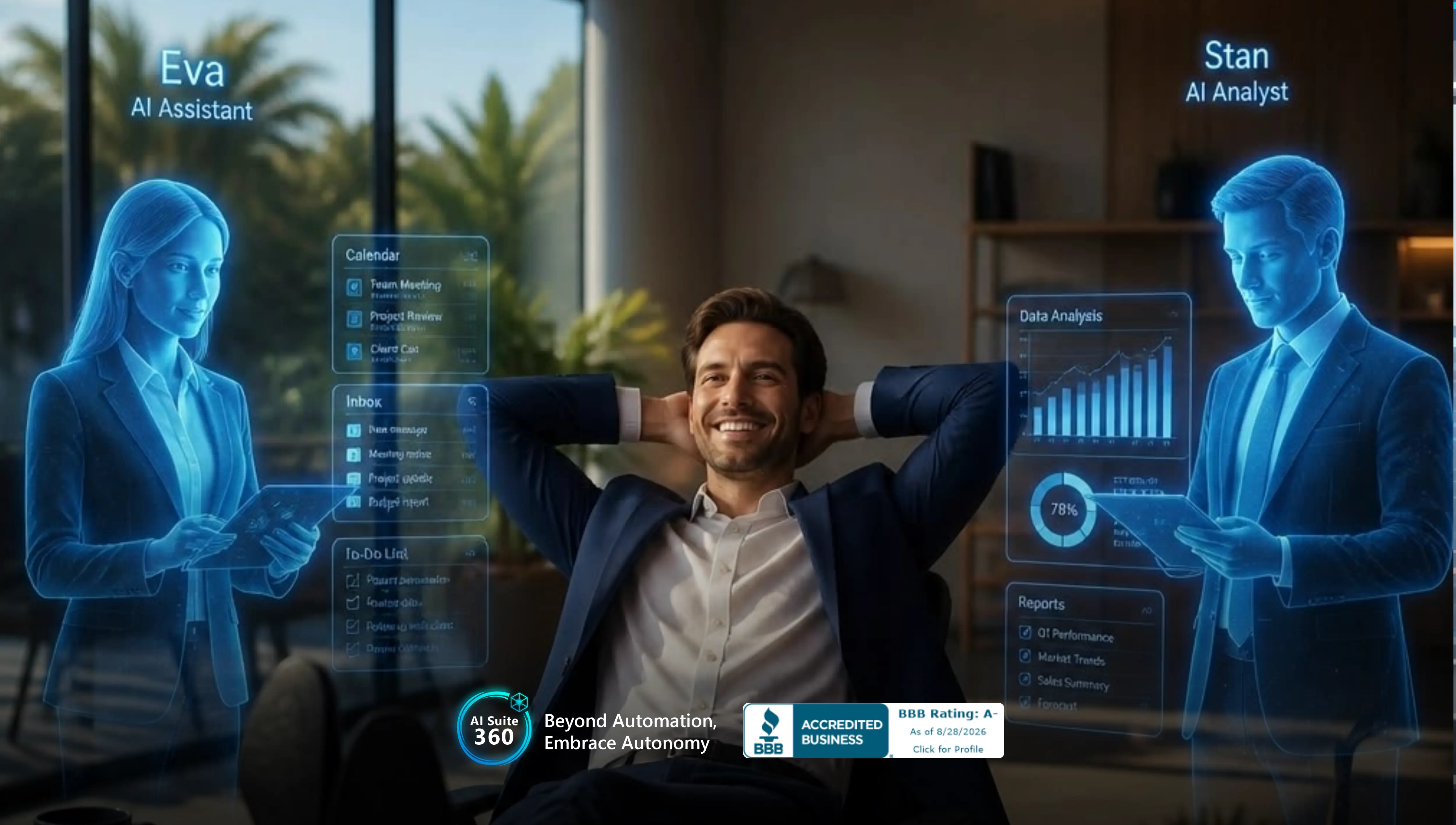
That's the thinking behind AI Suite 360's multi-agent architecture — specialized agents working across revenue, content, communications, customer intelligence, and business operations.
Want to see how it would map to your operation? AI Suite 360 is at 32 E Fairmount Ave, Maywood, NJ 07607.
AI Automation vs Hiring More Employees: The Verdict
For most small businesses, the answer isn't AI or people. It's both, deployed intelligently.
Hire humans for work that rewards human ability. Automate everything else.
Don't pay skilled people to do work a system can do reliably. And don't automate the moments where trust, judgment, and real relationships decide the outcome.
The advantage goes to the owners who know the difference.
Get it right and you respond faster, run leaner, deliver a more consistent customer experience, and grow without adding a salary every time the workload spikes.
The question is changing. It used to be:
"Who do we hire next?"
Now it's:
"What should our people actually be spending their time on?"
Answer that one well, and the economics of your entire business change.
Frequently Asked Questions
1. Is AI automation cheaper than hiring employees?
For repetitive, high-volume work, usually yes. But it depends on the task. Compare technology and implementation costs against the full cost of hiring — recruiting, onboarding, benefits, management time, and turnover — not just the salary.
2. Can AI automation completely replace employees?
No. AI handles administrative work, communication, marketing, data processing, and follow-up extremely well. Judgment, leadership, relationships, physical work, and complex decisions still need people.
3. What small business tasks are best suited for AI automation?
Lead qualification, follow-up sequences, appointment scheduling, CRM updates, customer segmentation, content production, reporting, market research, routine communication, and workflow management.
4. Is AI automation only useful for large companies?
It's arguably more useful for small ones. Small teams have fewer people wearing more hats, so removing repetitive work frees up a bigger percentage of capacity — and lets you scale without hiring immediately.
5. How should a small business start using AI automation?
Start with the bottlenecks. Find the repetitive processes eating the most time, then map how leads, customers, communication, and data actually move through your business. Decide what should be automated and what stays human-led. An AI architecture assessment can help you spot where automation will deliver the biggest financial and operational return.
Related Posts
25 Business Tasks Can Automate With Ai
Ai Agent Pricing and Buying Guide in Maywood