AI Receptionist vs. Human Receptionist: Cost Comparison
An undelivered call might be an appointment, sale or service call. When hiring a receptionist for a growing business, you can hire a human receptionist, an AI receptionist, or both. There are more factors to consider besides the monthly cost. Other decisions to be made are based on coverage hours, call volume, complexity and the value of a personal interaction.
A receptionist using AI is a software application that answers and answers incoming calls using speech recognition and using conversational AI. It can answer frequently asked questions, collect the details of callers, redirect and send them for an appointment, based on its configuration.
A human receptionist provides live real-time interaction, personal judgement, human communications and at times a human face at the front. No, it is different services and a proper comparison starts with deciding on what services you want and what action you are looking to get.
What does a human receptionist cost?
According to the U.S. Bureau of Labor Statistics, as of May 2025, a receptionist in the U.S. makes a median hourly wage of $18.27, or $38,010 annually.2 This is $3,168 per month before employer costs, assuming a standard 40-hour workweek. Actual pay may differ depending on location, job experience, industry, job duties and work hours.
Wages are only part of the employment expense. Employers may also pay payroll taxes, workers’ compensation, health or retirement benefits, paid leave, recruiting, and training. The actual total varies by location and benefits package. The IRS explains the employer’s responsibilities for Social Security, Medicare, and federal unemployment taxes in its employment tax guidance.
These costs buy meaningful strengths. A human receptionist can welcome visitors, recognize context, handle interruptions, and respond with empathy. They may notice when a caller is distressed or when a request does not fit a standard process. If the role includes reception, scheduling, and administrative support, the employee may contribute value beyond answering calls.
What does an AI receptionist cost?
AI receptionist pricing depends on the provider, the number of included call minutes, the integrations it supports, and usage fees. My AI Frontdesk offers a plan for $99 per month with 200 voice minutes, and has a few extras like chat and SMS.3, which is an annual billing plan with overage charges. The examples demonstrate that there is more to the headline subscription price.
Make sure to review minutes that are included, how overages are handled, if there is any additional setup or integration fee, and if the plan you're reviewed offers the features that you require. The cost for a custom set up of a voice agent can involve telephony costs, software costs, and maintenance costs. Some plans include messaging or CRM capabilities or on voice.
Estimate the time for a call by referring to the history view. If the business receives 100 calls each month, and the caller hangs up after an average of 3 minutes, then this is 300 minutes, excluding retries, transfers, etc., which are billable. If you don't follow the limitations of the plan, a plan that has a low monthly payment could end up costing more. Ask each provider how they count the minutes, what they do if they reach the end of the minutes and if the minutes ever expire.
An AI receptionist is capable to respond to calls throughout the day and can in addition handle a number of calls concurrently (based on system and plan). It can capture the callers' info, reply to yes/no inquiries, divert calls, or arrange appointments.
When limits are called for: extreme requests, situations, bad sound or misinformation may result in a referral back to an individual. The next step will be for businesses to make sure that call recordings, also referred to as call transcripts, are stored safely and who is able to see them.
Side-by-side cost comparison
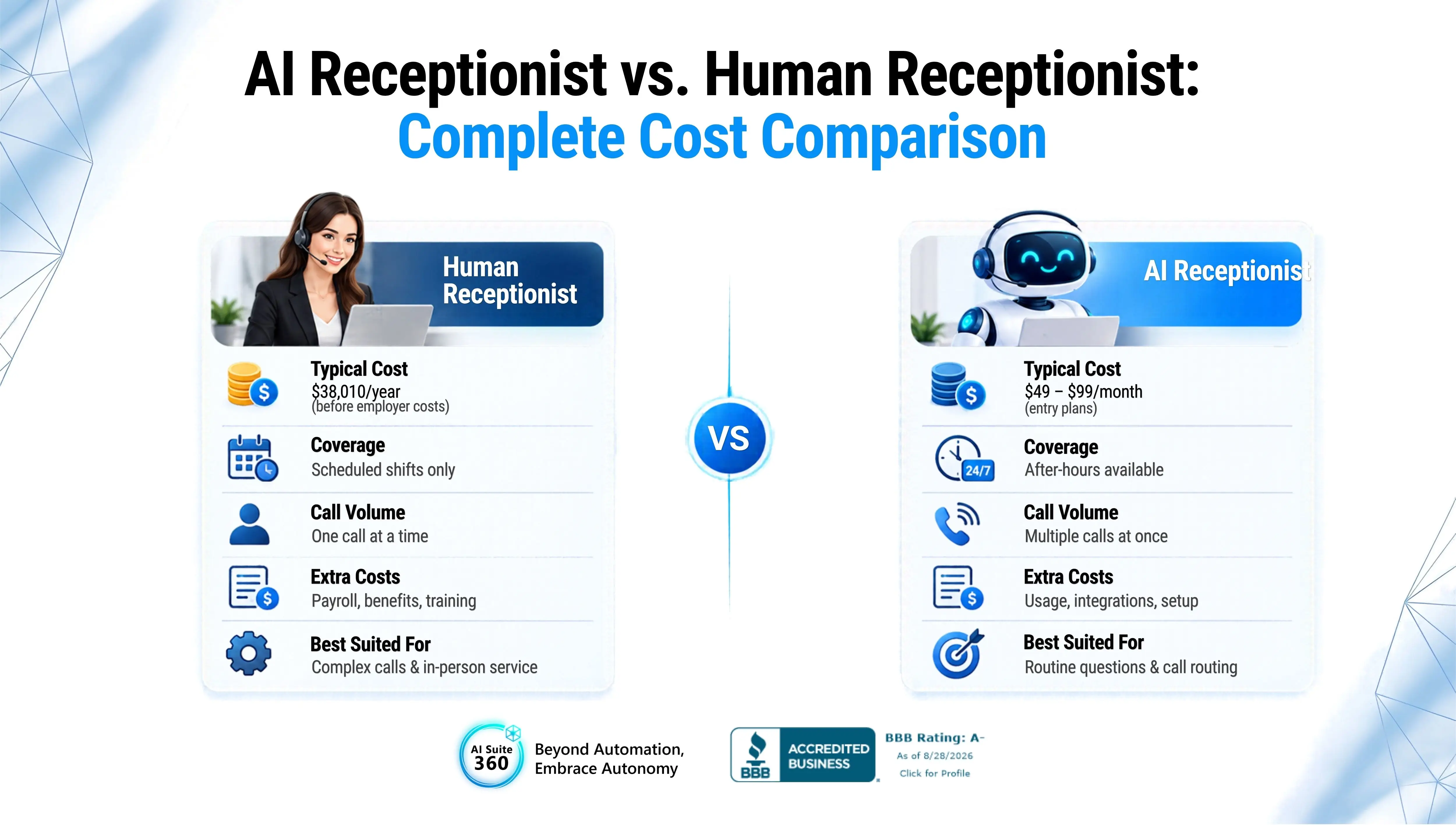
Cost factor | Human receptionist | AI receptionist |
Typical direct price reference | U.S. median wage: $18.27/hour or $38,010/year, before employer costs | Published examples range from $49/month to $99/month for entry plans, with different usage allowances |
Coverage | Usually scheduled shifts; extra coverage can mean additional staffing or overtime | Can provide after-hours coverage; availability and capacity depend on the provider and plan |
Call volume | One person handles one conversation at a time | May handle simultaneous calls, subject to configuration and limits |
Extra costs | Payroll taxes, benefits, leave, hiring, training, and coverage | Usage overages, phone numbers, integrations, setup, and custom support may cost extra |
Best suited to | In-person service, complex calls, judgment, and personal relationships | Routine questions, call routing, booking, overflow, and after-hours answering |
The figures are not an equal-feature comparison. A receptionist’s wage buys human labor for scheduled hours; an AI plan buys a specific service allowance under a vendor’s terms. Compare the workload and coverage you need rather than treating the lowest price as a like-for-like replacement. Also check the dates and terms on vendor pricing pages because rates and plan allowances can change.
A simple way to compare total cost
Use the full salary plus employer taxes, benefits and paid leave and hiring or training cost of your receptionist. Include any cost needed for times that that employee is unavailable. Then you compare that with the cost of the AI subscription plus overages, phone calls, integration fees and any human escalation coverage you must keep.
The good rule-of-thumb is to simply multiply the monthly subscription cost by the number of months it will be up and running, then add to that the phone charges or the telephony, setup and integration costs, and the human coverage for escalations. For a human receptionist, add in wages, employer taxes and benefits, paid leave/coverage, recruiting and training.
Some expenses are up-front and one-time and not part of the monthly billings; make sure to separate these out, otherwise it could be a short-term one-time fee that skews the comparison. For instance, companies with a small, predictable volume of traditional phone requests could be satisfied with a base business-grade AI solution for answering missed calls and after-hours calls.
If there is high demand at the office, but the minutes that they are allotted are kept low, the High Minute may be more suitable or perhaps a mixed plan is appropriate. Base your call estimates on your own calls, not a provider's 'best initially' scenario.
Which option is right for your business?
Use a human receptionist if there is a need for in-person service, when judgmental or emotional support are part of the call frequency, or if personal service is an integral part of your brand. Where there are complex intakes, high stakes interactions, a lot of solicitations for exceptions, or customers that will continue to interact with a person, a live receptionist will likely be the right option.
Consider AI when there are routine questions coming from customers, you need to capture inquiries outside of business hours and have a consistent process or your volume of inquiries has causes you to miss opportunities. It can be very helpful when the same basic information is called for over and over, or when staff have to step away from their work on basic calls. Prior to launch to define what it can reply, what it can then gather, and when to provide or escalate a call.
A hybrid is feasible for many small businesses: back them up with a human reps for more complicated, face-to-face interactions and use AI for basic interactions or to smooth the edges around staff hours outside of the office.
This will prevent all callers from being meant in automation, but still keep some redundancy. Check and update questions and responses including call outcomes frequently and allow callers to easily connect directly to an agent when it is required. Businesses in Maywood can have local contact information in their website and calendar designs, including 32 E Fairmount Ave, Maywood NJ 07607. Ensure that address and service details are correct throughout all communications of your AI Receptionist.
The bottom line
An artificial receptionist is significantly more budget-friendly than hiring a regular receptionist for basic reception work but this comes with various drawbacks. Staffing involves employee-related expenses and face-to-face judgment and support. AI pricing will be affected by the number of uses and extent of use, and it might still require the intervention of a human hand. This is comparable to the general cost of reliably dealing with the actual volume of calls—actually not up to excuse the expression, but up to the total cost of the actual volume of calls.
Don't label them, just read through a list of sample calls and categorize them based on what they are, routine, judgment or have a need for a human response. Assign prices to each option relative to that task list and follow up on answers, booking, escalations, caller feedback and total pricing in a pilot.
FAQs
1. Is an AI receptionist cheaper than a human receptionist?
The cost of an AI receptionist is significantly lower than that of a human receptionist. However, there needs to be some limits of use, overages, integrations, set-up, and human support to consider for a fair comparison. However, the cost of human labour is not just wages. The question is, can the AI service do the job and provide the coverage when you need it at the actual monthly rate?
2. What is the monthly cost of a human receptionist?
With the average BLS wage of $38,010 for an annual basis, that comes out to approximately $3,168 each month. This is not a fully loaded employer cost and employer taxes, benefits, paid leave and other factors will vary by location.
3. What is the monthly fee for an AI receptionist?
Published examples vary. As of this writing, My AI Frontdesk offers a plan of $99 per month, with 200 voice minutes, while Centricall offers a $49 plan for 50 voice minutes. Be sure to review vendor pages for current overage charges, features included and billing terms before deciding on a plan before custom integrations or higher call volume may result in a higher plan.
4. Is a receptionist completely replaceable by an AI receptionist?
Can take over routine, repetitive tasks that are defined; may not be suitable for all calls or in-person responsivities. Escalation cases must be identified, test with scenarios, provide a human option for complex and sensitive requests. Check performance after the launch and revise workflow if caller are misrouted or partial answers are being provided.
Footnotes
1.U.S. Bureau of Labor Statistics, Receptionists. May 2025 wage data. ↩ ↩2
2.Internal Revenue Service, Understanding Employment Taxes. ↩
3.My AI Frontdesk, Pricing. Vendor pricing and included usage can change. ↩ ↩2
4.Centricall, Pricing. Vendor pricing and included usage can change. ↩ ↩2
Related Posts
How Ai Agents Transform Business Operations
How business Use Ai to Automate Social Media Markerting