How AI Agents Transform Business Operations & Workflows
How AI Agents Can Replace Manual Business Tasks
Running a business should be about growth, strategy, customers, and innovation. Yet for many small business owners, a surprising amount of the workday disappears into repetitive tasks.
Following up with leads. Updating the CRM. Sending appointment reminders. Answering routine customer questions. Creating content. Checking performance metrics. Scheduling meetings. Moving information between systems.
Individually, these tasks may only take a few minutes. Together, they can consume hours every week.
This is where AI agents are changing business operations.
Unlike basic automation that simply follows a predefined sequence, AI agents can work toward a goal, use connected tools, process information, make decisions within established parameters, and execute multiple steps of a workflow. According to IBM’s overview of AI agents, AI agents can autonomously perform tasks by designing workflows and using available tools.
For growing businesses, this creates an opportunity to move from manually managing individual tasks to building systems that continuously execute them.
What Are AI Agents?
An AI agent is an artificial intelligence system designed to perform tasks on behalf of a person or another system.
Traditional software generally waits for a specific command.
An AI agent can be given an objective and determine which approved actions and tools are necessary to accomplish it.
For example, traditional automation might be programmed to send an email when someone completes a contact form.
An AI agent could potentially take the process further by:
Reviewing the new lead
Categorizing the inquiry
Updating the CRM
Personalizing the first response
Starting an appropriate follow up sequence
Offering available appointment times
Monitoring whether the prospect responds
Escalating the conversation to a human when necessary
That distinction matters.
The goal is no longer simply automating one task. Businesses can increasingly automate connected workflows.
McKinsey’s research on agentic AI highlights this potential, noting that agents can support complex business workflows involving multiple steps, systems, and participants.
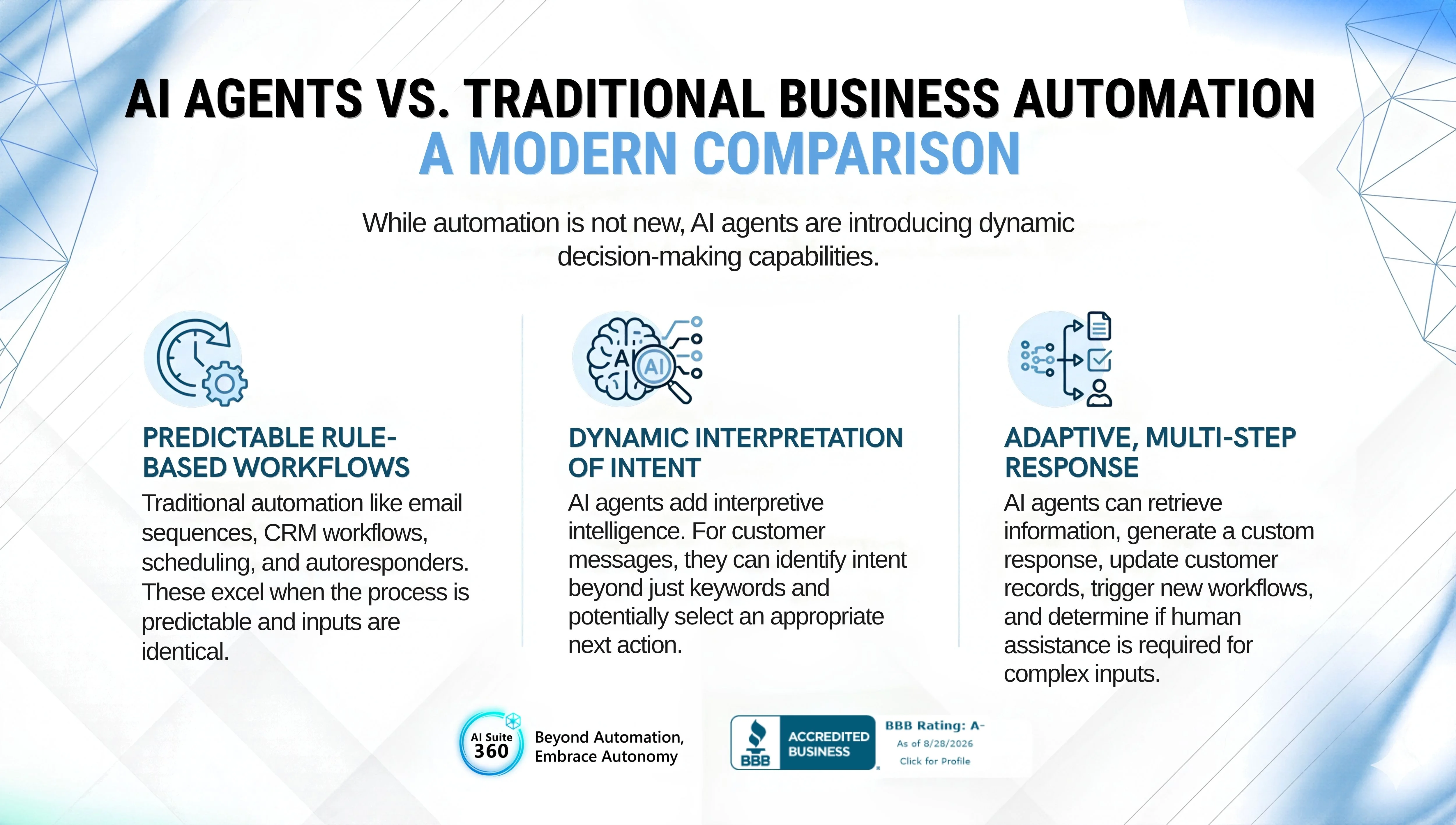
AI Agents vs. Traditional Business Automation
Business automation is not new.
Companies have used email sequences, CRM workflows, scheduling software, autoresponders, and integrations for years.
Traditional automation works especially well when the process is predictable:
If X happens, perform Y.
AI agents add another layer because they can potentially interpret information and determine the next appropriate action.
Consider an incoming customer message.
A traditional automation may recognize a keyword and send a predetermined response.
An AI agent can potentially identify the customer's intent, retrieve relevant information, select an appropriate response, update the customer record, trigger another workflow, and determine whether human assistance is required.
That makes AI agents particularly useful for processes where the steps are repetitive but the inputs are not always identical.
7 Manual Business Tasks AI Agents Can Handle
1. Lead Capture and Qualification
Speed matters when a potential customer expresses interest.
A business owner who is serving customers, attending meetings, or working in the field may not see a new inquiry for several hours.
AI agents can help create a more responsive lead management process.
Depending on the systems connected to them, agents can capture inquiries, organize lead information, identify relevant characteristics, update CRM records, initiate conversations, and route qualified opportunities.
Instead of manually reviewing every incoming lead, your team can concentrate attention on conversations that genuinely require human involvement.
2. Lead Follow Up and Nurturing
While a lot of businesses are good at lead generation, they often fall short with follow up.
Someone has to keep track of who needs yet another e-mail, who asked for more details, who didn't show up for an appointment, and who didn't reply.
AI agents can coordinate follow up across channels such as email, SMS, messaging, and CRM workflows.
More significantly, an agentic system can leverage the context of past interactions to decide on what to do next.
This is where there is a significant difference between automated messages and a customer journey.
3. Appointment Scheduling and Reminders
Scheduling can create a surprising amount of administrative work.
A customer asks for an appointment. Someone checks the calendar. Several messages go back and forth. The appointment is booked. A reminder must then be sent.
When connected to scheduling and communication systems, AI agents can potentially handle much of this workflow.
They can help identify available times, facilitate booking, send reminders, follow up after missed appointments, and trigger appropriate next steps.
The result is less calendar management for employees and a faster experience for customers.
4. Customer Service and Routine Questions
Your team probably answers many of the same questions repeatedly.
What are your hours?
How does your service work?
Where is my order?
How do I reschedule?
What happens after I book?
AI agents can use a business knowledge base to respond to common inquiries while maintaining context throughout the conversation.
More complicated or sensitive issues can then be escalated to a person.
This model does not require removing people from customer service. Instead, it allows employees to spend more time handling situations where empathy, judgment, negotiation, or specialized expertise actually matters.
5. Content and Marketing Operations
Content creation involves much more than writing a social media post.
Businesses may need to research topics, develop ideas, write articles, create email campaigns, repurpose long form content, produce social posts, organize publishing calendars, and evaluate performance.
A network of specialized AI agents can divide those responsibilities.
One agent might research a topic.
Another develops the draft.
Another adapts it for email.
Another creates social content.
Another analyzes campaign performance and identifies opportunities for improvement.
This multi agent approach is one reason AI architecture is becoming increasingly important. IBM describes multi agent workflows as systems where specialized agents can collaborate under an orchestration layer to complete more complex processes.
6. CRM and Administrative Tasks
A CRM is useless if the data that's stored in it is outdated and inaccurate.
Unfortunately, CRM maintenance is precisely the sort of work busy teams are apt to delay.
AI agents can assist in handling repetitive administrative tasks like updating contact details, categorizing leads, logging interactions, initiating workflows, organizing tasks, and identifying records for follow-up.
The system is integrated into the employee's workflow so that employees don't have to do the maintenance continuously.
7. Reporting and Business Intelligence
Business owners often have access to plenty of data but very little usable insight.
Website analytics may live in one platform. Sales information is somewhere else. Advertising performance is stored in another dashboard. Customer information sits inside the CRM.
Someone still has to interpret everything.
AI agents can continuously monitor connected data sources and help identify patterns, anomalies, changes, and opportunities.
Instead of asking, “What happened last month?”, businesses can build systems designed to surface relevant information as conditions change.
That can make business intelligence more proactive rather than purely retrospective.
From Individual AI Tools to AI Architecture
The bigger opportunity is not having dozens of independent AI tools.
It is getting those systems to work together.
Imagine a prospect visits your website and submits an inquiry.
A lead capture agent collects the information.
A qualification agent evaluates the lead.
A communication agent begins follow up.
A scheduling agent helps book an appointment.
The CRM is updated automatically.
A business intelligence agent monitors the conversion.
The information stays connected throughout the customer journey.
This is the idea behind AI architecture: specialized agents, shared business data, connected systems, and coordinated workflows operating as one environment.
Businesses exploring this model can connect with AI Suite 360 at 32 E Fairmount Ave, Maywood, NJ 07607 to learn how an AI architecture can be structured around their existing operations.
Does AI Replace Employees?
The more useful question is often whether AI can replace tasks, rather than entire roles.
A single employee may perform dozens of different activities during the workweek. Some require creativity, leadership, empathy, accountability, or nuanced judgment. Others are repetitive and process driven.
AI agents are particularly valuable for the second category.
McKinsey estimates that currently available technologies could theoretically automate more than half of current U.S. work hours, while emphasizing that this represents technical potential rather than a forecast of job losses.
For business owners, the practical goal is to determine which activities require human expertise and which can be delegated to technology.
Your people can then spend less time copying information, chasing routine follow ups, and maintaining disconnected systems and more time serving customers, solving problems, building relationships, and growing the company.
Where Should a Business Start With AI Agents?
Do not begin by asking, “How many AI agents can we deploy?”
Start with the workflow.
Identify repetitive activities that consume time, delay customer responses, create bottlenecks, or regularly fall through the cracks.
Then map:
Trigger → Decision → Action → Next Step → Outcome
Once the workflow is clear, determine which steps can safely be handled by AI, which require integrations with existing systems, and where human approval should remain.
AI agents still require appropriate goals, access controls, monitoring, data governance, and escalation rules. Autonomy should not mean operating without accountability.
The strongest AI architecture combines automation with appropriate human oversight.
The Future Is Autonomous Business Operations
The transition from traditional automation to AI agents represents a significant change in how businesses can operate.
Traditional automation asks:
What repetitive action can software perform for us?
Agentic AI asks:
What business outcome can a coordinated system work toward?
That opens the door to a much broader transformation.
Lead generation, customer communications, scheduling, content production, CRM administration, reporting, and operational workflows no longer have to exist as disconnected processes.
They can become parts of one coordinated architecture.
For small businesses and startups, that means growth may no longer require adding administrative headcount at the same rate as operational complexity.
The objective is not AI for the sake of AI.
It is a business where repetitive work happens consistently, customers receive faster responses, information moves between systems, and people have more time for the work that actually requires people.
AI Suite 360 helps businesses explore this transition through a connected AI architecture designed around revenue, content, communications, intelligence, and operations. Businesses interested in exploring an AI agent strategy can also connect with the team at 32 E Fairmount Ave, Maywood, NJ 07607.
Frequently Asked Questions
What are the possible business processes that can be automated using AI?
AI agents can assist with various tasks such as lead capture, lead qualification, follow up, appointment scheduling, customer service, CRM updates, content workflows, reporting, data analysis and other repetitive administrative tasks. The functionality will vary based on the agent, integrations, data access, and controls used by the business.
What does an AI agent do? What is the difference between AI agents and chatbots?
The main way a chatbot communicates with a user is by speaking with them. Imagine an AI agent that could plan, search for authorized tools or data, make decisions within specified constraints, and take action!An AI agent that can plan, search for authorized tools or data, make decisions within specified constraints, and take action! Learn about the distinction between AI agents and AI assistants from IBM.
3. Are AI agents the replacement for employees?
AI agents can be more thought of as tools to automate certain tasks and workflows, and not as a complete job replacement. Needs for leadership, complex judgment, building relationship, sensitive decisions, exceptions, strategic oversight have a high human involvement.
AI agents can be utilized by small businesses?
Yes. Small businesses can particularly benefit from AI agents because time-consuming administrative tasks can eat into a small team's valuable time. The best way to do it is to select workflows that are good candidates for automation because there's a clear benefit to be reaped from using AI.
6. What are the risks associated with using AI agents in business?
They may be put in place with safeguards in mind, but the level of security is dependent on the design and management of the system. Before delegating to an AI agent the ability to take actions with consequences, businesses should discuss with the AI provider what data the AI can access, how it will be accessed, who will be able to audit the AI's actions, who will be able to approve or disapprove the AI's actions, what privacy rules the AI needs to follow, how the AI will monitor itself, and what will happen if something goes wrong.
Build a Business That Works Beyond the Workday
Every repetitive task your team performs manually has a cost.
Sometimes that cost is payroll. Sometimes it is slow response time. Sometimes it is a missed lead, an inconsistent customer experience, or a business owner spending another evening catching up on administrative work.
AI agents create an opportunity to rethink those processes from the ground up.
Instead of adding another disconnected tool, businesses can build an intelligent architecture in which specialized AI agents coordinate work across revenue, communications, content, customer engagement, intelligence, and operations.
Go beyond automation. Embrace autonomy.
Related Posts