How Autonomous AI Systems Are Changing Businesses
Artificial intelligence just crossed a line. For a decade, businesses used automation to knock out repetitive tasks. A form came in, an email went out. A sale closed, a CRM record updated. A meeting got booked, a confirmation fired. Useful. Genuinely time-saving. And completely dependent on somebody writing the instructions first.
Autonomous AI systems have broken that ceiling. Rather than executing one command at a time, these systems analyze information, decide what should happen next, coordinate tasks across departments, and reach for multiple tools to pursue a business objective you defined once.
That single change is rewriting how companies handle sales, marketing, customer communication, operations, and decision making.
Here's how autonomous AI systems are changing businesses, and what the shift really means for small and growing companies.
What Are Autonomous AI Systems?
An autonomous AI system completes multi-step processes with far more independence than traditional automation ever allowed.
Old automation follows one shape:
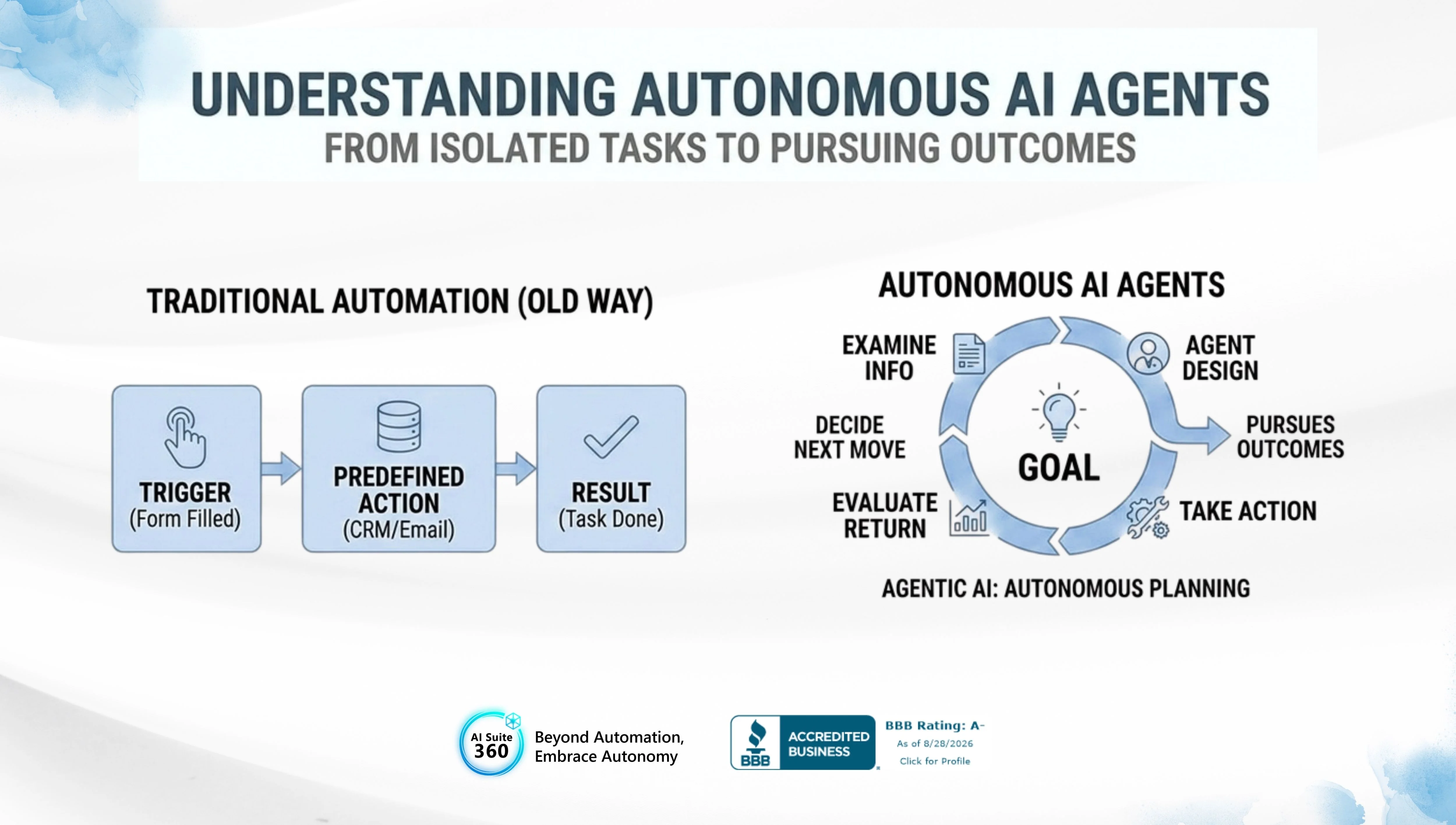
Trigger → predefined action → result
Autonomous AI slides reasoning into the middle of that chain.
Give an agent a goal. It examines the available information, picks from the tools it's permitted to use, takes action, evaluates what came back, and decides the next move.
IBM describes AI agents as systems capable of autonomously performing tasks by designing workflows and utilizing available tools. (ibm.com)
Sit with that word for a second. Autonomously.
Businesses have stopped asking AI to finish isolated tasks. They're starting to hand AI systems actual responsibility inside the operation.
From Business Automation to Business Autonomy
Traditional automation is excellent when a process never changes.
Take a basic lead workflow. Someone fills out your contact form.
Traditional automation responds:
Add the contact to the CRM → send an email → notify a salesperson.
Fine. Fast. Finished.
An autonomous system doesn't stop there.
It analyzes the lead, checks the prospect against your ideal customer profile, personalizes the message, selects the right follow-up sequence, tracks engagement, schedules more outreach when interest appears, and escalates the genuinely qualified opportunities to a human being.
The workflow isn't executing instructions anymore.
It's pursuing an outcome.
That's exactly why agentic AI has captured so much executive attention. Gartner named it a top strategic technology trend, describing systems that autonomously plan and take actions to meet user-defined goals. (gartner.com)
How Autonomous AI Systems Are Changing Businesses
This isn't a single-department story. Autonomous systems increasingly coordinate work across sales, marketing, customer service, analytics, and internal operations at the same time.
1. Businesses Respond to Leads Faster
Speed decides deals. When somebody raises their hand, the clock starts.
The traditional version depends on an employee noticing a form submission, opening the CRM, researching the prospect, and finally typing a response. Maybe today. Maybe tomorrow morning.
AI collapses that timeline to minutes.
An autonomous revenue system can:
Capture incoming leads
Analyze customer information
Score or categorize opportunities
Personalize initial communication
Trigger follow-up
Coordinate email, SMS, or chat
Schedule appointments
Update CRM records
Notify a human the moment intervention is needed
Your people stop babysitting every step and start spending their hours in the conversations where expertise and judgment actually change the outcome.
2. Customer Communication Is Becoming Context Aware
Early business chatbots were scripts wearing a costume.
Customers clicked predetermined options, or typed questions that had to match an existing answer almost word for word. Everyone hated it.
Modern AI systems work with real context.
Before responding, an agent can reference CRM records, prior conversations, customer details, knowledge bases, and your business rules.
That moves companies away from generic automated blasts and toward interactions shaped by who the customer is and what they're dealing with right now.
The goal was never to send more messages.
It's to send the right one at the right moment.
3. Marketing Can Operate as a Connected System
Marketing teams have used AI for content generation for years now. That part isn't new.
Autonomous AI expands the idea considerably.
Instead of asking AI to write one blog post or caption, you build a system that coordinates the whole marketing process.
An AI-powered marketing architecture can support:
Audience research
Customer segmentation
Topic identification
Content planning
Blog creation
Social content
Email campaigns
Content repurposing
Performance analysis
Campaign optimization
The real breakthrough is coordination.
Your content system can pull from customer intelligence and performance data to decide what gets created next week.
At that point AI stops being a content tool. It becomes marketing infrastructure.
4. AI Agents Can Work Together
The most consequential development in this space is the rise of multi-agent systems.
Rather than forcing one AI model to handle everything, organizations deploy specialists.
One agent analyzes leads.
Another handles communications.
Another produces marketing content.
Another watches business performance.
Another runs operational workflows.
Then they share information and coordinate action inside a larger architecture.
Microsoft describes multi-agent systems as environments where multiple AI agents work together to perform complex tasks, including scenarios where agents specialize in different functions. (microsoft.com)
Notice how familiar that sounds.
No sane company asks one employee to simultaneously run sales, support, accounting, content, and analytics.
Specialization works for AI for the same reason it works for people.
5. Business Intelligence Is Becoming Continuous
Most business reporting looks backward.
Someone gathers data. Builds a report. Reviews the numbers. Spots a problem. Escalates it. Eventually, something gets done.
By then the month is over.
AI shortens that loop dramatically.
Instead of waiting for a human to go looking, autonomous systems monitor your defined data sources constantly and flag changes as they happen.
Businesses can watch:
Lead volume
Conversion rates
Customer engagement
Sales pipeline activity
Marketing performance
Customer behavior
Operational bottlenecks
Revenue trends
The system surfaces what matters, or kicks off an approved workflow on its own.
That's continuous monitoring and response replacing periodic reporting.
6. Administrative Work Becomes Exception Based
Think about how much of your team's day disappears into routine process.
Updating records.
Routing requests.
Moving data between systems.
Scheduling appointments.
Generating documents.
Sending reminders.
Checking whether someone did the thing they said they'd do.
Autonomous systems flip the human role from completing every routine step to handling the exceptions.
AI takes the predictable work inside boundaries you set.
People step in when the moment calls for judgment, approval, creativity, empathy, negotiation, or accountability.
Read that distinction carefully, because it's the whole game. Successful AI adoption isn't about removing humans. It's about deciding where human attention creates the most value.
7. Small Businesses Can Access Capabilities Once Reserved for Enterprises
Big companies always held one advantage that money alone couldn't overcome quickly: specialized teams.
Separate departments for sales operations, marketing, customer service, analytics, research, and administration. Depth at every position.
Small businesses could never match it.
AI has bent those economics.
A growing company can now support work across multiple business functions without opening a new role for every operational gap.
This doesn't mean AI replaces your team.
It means capacity can grow without headcount growing at the same pace.
For entrepreneurs and small business owners, that may be the single most consequential effect of autonomous AI.
Want to talk through how this applies to your operation? Connect with the team at:
32 E Fairmount Ave, Maywood, NJ 07607
The Difference Between AI Tools and AI Architecture
Most businesses collect AI tools one purchase at a time.
One writes content.
One sends email.
One manages the CRM.
One books meetings.
One reports analytics.
One handles chat.
Each works fine on its own. That's not the issue.
The issue arrives a year later, wearing a familiar face:
Who coordinates all of them?
Usually the owner. At night. On a Sunday.
That's the problem AI architecture solves. An architecture connects agents, applications, customer information, workflows, business rules, and data so the parts operate as one machine.
It's the thinking behind AI Suite 360.
Rather than shipping another standalone productivity tool, AI Suite 360 is built as a multi-layer architecture of specialized AI agents working across revenue, content, communications, business intelligence, customer engagement, and operations.
The difference lands where it counts.
A collection of AI tools makes individual employees more productive.
A coordinated AI architecture aims to make the business itself more intelligent and responsive.
What Does an Autonomous Business Actually Look Like?
It doesn't look like an empty office.
It looks like routine operational activity happening without anyone manually pressing start.
Follow a single prospect through it.
Someone finds your business online at 11 p.m.
The system captures the lead.
An agent analyzes the prospect.
Another decides the right communication strategy.
A communication agent opens personalized follow-up.
The CRM updates itself.
The prospect books an appointment.
The system logs the interaction.
Business intelligence agents track conversion performance.
Marketing systems fold that performance data into the next campaign.
Meanwhile your people own strategy, relationships, oversight, approvals, and the decisions that carry real weight.
The architecture handles the coordination.
That is a different universe from bolting a chatbot onto your homepage.
Autonomous AI Still Requires Human Governance
Autonomy is not a blank check.
Any business adopting autonomous AI needs firm, documented limits on what these systems can access and which actions they're allowed to take.
The NIST AI Risk Management Framework gives organizations a practical structure for managing AI-related risk.
Work through each of these deliberately:
Data privacy
Access permissions
Human approval requirements
Security
Accuracy
Decision logging
Monitoring
Escalation procedures
Regulatory requirements
High-impact actions need real safeguards.
An agent drafting a follow-up email carries almost no risk. An agent independently approving a financial transaction is a completely different conversation.
Autonomy performs best when the boundaries are drawn on purpose, before deployment rather than after an incident.
Why 2026 Is a Pivotal Year for Autonomous AI
The business AI conversation has changed twice in three years.
Phase one belonged to generative AI. Companies asked AI to create something.
Write an email.
Summarize a meeting.
Draft a blog post.
Analyze a document.
Phase two belongs to agentic AI. Companies now want AI to do something.
Research the customer.
Update the CRM.
Coordinate the campaign.
Run the workflow.
Monitor the results.
Choose the next approved action.
That jump from generation to execution is precisely what makes autonomous AI matter to operations rather than just to marketing departments.
Preparing Your Business for Autonomous AI
Nobody needs to automate everything this quarter.
And automating a broken process just gives you a faster broken process. Same mess, more velocity.
Start by mapping your repetitive work and operational bottlenecks.
Look for the activities that eat hours, delay customer responses, produce inconsistent follow-up, or force employees to move the same information between systems over and over.
Then answer four questions:
What must stay under human control?
What can run on fixed workflows?
What needs AI interpretation?
What could eventually operate autonomously inside defined guardrails?
That framework lets you introduce autonomy on purpose, instead of adopting AI because everyone else is talking about it.
The Future Is Bigger Than Automation
Here's the part most coverage misses.
The biggest change autonomous AI brings isn't that you can automate more tasks. It's that you can design the operation itself differently.
Traditional automation asks:
"How do we make this task happen automatically?"
Autonomous architecture asks:
"How do these systems work together toward the objective?"
Different question. Different business.
The implications run through sales, marketing, customer experience, analytics, administration, and ultimately how far you can scale before the wheels come off.
Companies that get this right will still need human leadership, creativity, expertise, and accountability. Those aren't going anywhere.
But your people will spend far fewer hours coordinating processes that technology can now run on its own.
Frequently Asked Questions
1. What is an autonomous AI system?
An autonomous AI system pursues defined objectives with far less step-by-step human direction. Within its permissions, it analyzes information, selects tools, executes actions, evaluates outcomes, and determines the appropriate next step.
2. How are autonomous AI systems different from traditional automation?
Traditional automation follows predetermined rules: when X happens, do Y. Autonomous AI systems fold context and reasoning into the workflow, so the system can determine which approved action fits the information in front of it.
3. Can small businesses use autonomous AI?
Yes. Small businesses apply AI agents and automation to lead management, customer communication, scheduling, marketing, CRM administration, reporting, and content workflows. The right level of autonomy depends on your business, your data, and the risk attached to each task.
4. Will autonomous AI replace employees?
It reduces the human time required for repetitive and administrative work, but plenty of business functions still demand human expertise, accountability, relationship building, creativity, and judgment. The stronger play is redesigning roles so people spend more time on high-value work.
5. What should a business automate first with AI?
Start with high-volume, repetitive processes that have clear rules and measurable outcomes. Lead routing, CRM updates, appointment reminders, routine customer inquiries, internal reporting, and content workflows are the usual entry points. Consequential decisions deserve stronger oversight and tighter controls.
Build an AI Architecture for Your Business
AI Suite 360 is built for businesses ready to move past isolated automations and into a coordinated AI architecture.
Specialized AI agents work across revenue, content, communications, customer intelligence, analytics, and operations, connecting multiple business functions inside one intelligent system.
Explore AI Suite 360 to see how autonomous AI architecture applies to a growing business, or reach the team at:
32 E Fairmount Ave, Maywood, NJ 07607
Related Posts
Ai Automation vs Hiring More Employees
25 Business Tasks Small Companies